Bought a Domain, Then the Price Tripled? Here’s Why.

Founder, Notify.domains · ex-GoDaddy Director of Education · founder, DomainSherpa & DNAcademy
Last updated
You search on a registrar like GoDaddy, Namecheap or Dynadot, find a domain listed for $175, pay, and get a confirmation email. A few hours later you search the same name and it says $458. Your transfer is still pending. It feels like you got taken, or a bait and switch.
It almost never is. What looks like the registrar tripling the price on you is usually a handoff between two aftermarket systems that do not talk to each other.
You did not buy a fresh registration. You bought an already registered domain name that is listed for sale by the owner. Let me explain…
When a domain is already registered, a registrar search does not show a standard registration fee. It checks connected marketplaces and surfaces a listing from whoever currently owns the name. It doesn’t list all the marketplaces where it’s for sale — like Notify.domains does — it just lists a single price on a partner marketplace.
In a recent thread on r/Domains, a buyer purchased leverkit.com through Porkbun for $175 while the transfer sat in pending. Searching again later showed $458. The purchase was real. The higher number came from a different listing on a different platform.
What happens when you buy through a registrar marketplace integration
Registrars like Porkbun integrate with aftermarket networks so you can buy a listed name without leaving checkout. A typical flow looks like this:
- You search the domain at the registrar.
- The registrar finds it listed on a connected marketplace (in this case, Sedo) and shows that price.
- You pay the listed price.
- The registrar submits the purchase to the marketplace.
- The marketplace removes its own listing and contacts the current owner to start the transfer.
- Over hours or days, auth codes, locks, and approvals move the name into your account at the registrar you purchased it at.
During that window the domain is in motion. You own the transaction. You do not yet control the domain name. That is normal for aftermarket transfers, not a sign the deal failed.
Why the price on screen jumps after you pay
Aftermarket domains are often listed on more than one marketplace at once. Sedo, Afternic (GoDaddy’s network), Atom, Efty and others do not share one synchronized inventory. A seller (or their broker) can list the same name in multiple places at different prices. In fact, it’s to their advantage to get as much distribution for their for-sale domain name as possible.
In addition to that, registrars often integrate with several networks. When you buy through the cheapest listing, that marketplace pulls its offer offline. If you search again before the transfer finishes, the registrar no longer sees the Sedo listing, for example, you bought. It falls back to the next active listing it can find, often Afternic at a different price. And because Sedo and Afternic don’t communicate, it continues to reside on Afternic even after the Sedo sale happens.
That is exactly what happened with leverkit.com. The buyer locked in $175 on Sedo. With Sedo gone from the results, Porkbun surfaced the remaining Afternic listing at $458. Same domain, same pending transfer, different marketplace, different ask. It will not always triple, it just happened to triple here because that is the gap between those two listings.
That is a display quirk, not a second charge
You are not being asked to pay again. The registrar is not repricing your order. Search results reflect what is publicly listed right now, not what you already committed to in checkout.
If you are anxious, confirm in your account dashboard that the purchase and transfer request exist, watch for transfer approval emails, and give the process time. Aftermarket moves involve the seller, the marketplace, and two registrars. Same-day completion is not guaranteed.
Why the aftermarket works this way
Domain names are portable assets traded across independent platforms. There is no single source of truth for “the price of example.com.” Each marketplace holds its own listing until a sale closes on that platform.
Until the transfer completes, stale listings on other networks can still exist. Some sellers forget to delist everywhere. Some use different prices on purpose to test channels. Either way, a registrar search during a pending transfer can show a number that has nothing to do with your receipt.
Once the name lands in your account, you can remove any leftover listings on other marketplaces if you plan to keep the domain or simply ignore them and put the domain name to use.
What this means if you are watching a name you do not own yet
The same fragmentation that confuses buyers after checkout makes acquisition timing harder before you buy. One marketplace might show $175 while another shows $458, or $2,458. A listing can vanish from Sedo the moment someone else buys there, while Afternic still displays an older ask for months or years.
That is why monitoring more than one source matters. On domain monitoring on Notify.domains, the Marketplaces tab shows Afternic, Sedo, and other networks side by side when a watched name is listed. The Pricing chart tracks ask changes over time. When a listing drops off one platform or the price moves, you get the same alerts you already use for email, Slack, Telegram, and webhooks.
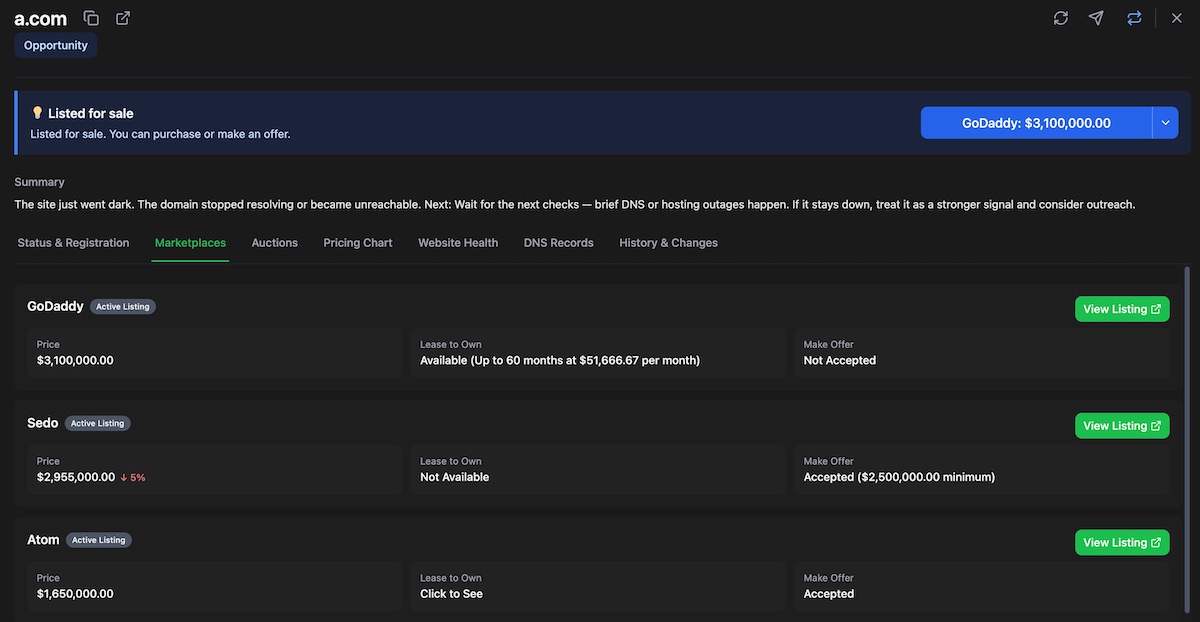
You see the full picture before checkout surprises you, and you catch the moment a cheaper path opens or a stale high ask finally disappears.
Who this helps
Founders and investors buying through registrar checkout, brokers explaining transfer delays to clients, and anyone building a shortlist from marketplace search results. In aftermarket acquisitions, the listing you see is only one channel’s view. The transfer you started is the deal that counts.
If you already monitor domains on Notify.domains, add the names you are pursuing and watch every marketplace path in one place. If you are still planning an acquisition, our guide on how to get a domain that is taken walks through listings, brokers, and backorders in order.
Be First to the Domain You Want
Get instant notifications the moment a domain name opportunity appears, with clear, step-by-step guidance to help you confidently secure it.
7-day free trial. No credit card required.