The Domain That Won’t Admit It’s About to Drop

Founder, Notify.domains · ex-GoDaddy Director of Education · founder, DomainSherpa & DNAcademy
Last updated
Most domain monitoring tools miss opportunities in ccTLDs because the data is incomplete, inconsistent, or intentionally hidden.
Notify.domains is built to close those gaps, so you see real availability signals others never surface — and can act before the rest of the market does.
Some country code domains will not tell you when they are expiring or close to being released.
The registry hides the expiration date, or returns a status that means nothing useful, and most monitoring tools simply go quiet.
That gap is exactly where valuable names slip away — not because they were competitive, but because no one saw them becoming available in time.
We built Notify.domains to read the small print that other tools skip.
When the registry hides the signal, we focus on the only thing that matters: the exact moment a domain can actually be registered.
Take a .be domain from DNS Belgium.
Look it up and a registered name and a name in quarantine return the same thing: NOT AVAILABLE.
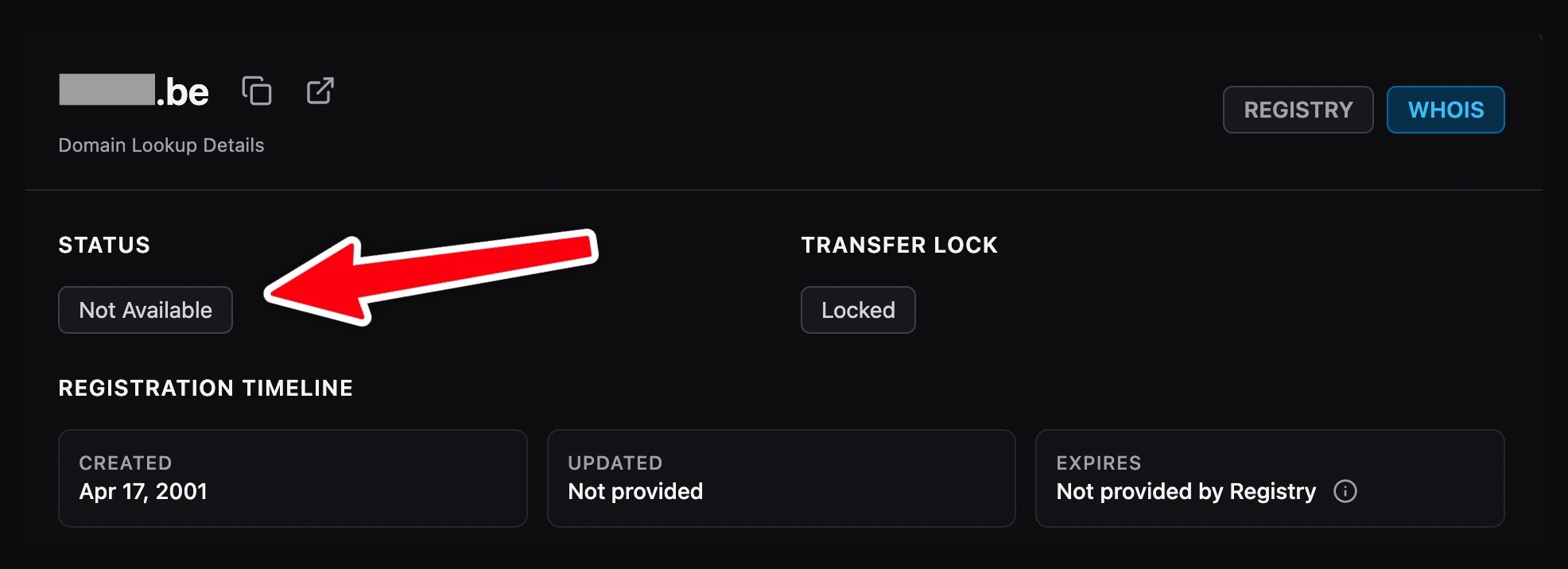
The quarantine phase, the holding period right before an expired name is released, is never exposed on public WHOIS.
Rather than invent a signal that is not there, we verify the real moment the name becomes registerable and alert you then.
No false “it is about to drop” emails, no guesswork.
In many cases, domains do not go straight from expiration to public availability.
Registrars often send them through exclusive auction partners first, and we track those paths as well — so if a name is headed to auction instead of dropping, you will know early enough to participate, not after it is already gone.
When the registry does expose it, we read it precisely
A .nl domain is the opposite case. Its registry, SIDN, exposes exactly what .be hides.
When an expired name enters quarantine, the registry reports it as pending delete and includes a “date out of quarantine,” the exact day the name is released for registration.
We capture both, mark the domain as heading for deletion, and show you the exact release date — so you can place a backorder or prepare to register it before the wider market reacts.
French domains under AFNIC, including .fr, .re, .pm, .tf, .wf, and .yt, do the same with a different word. There the post-expiration holding phase is called redemption. Same lifecycle, different vocabulary.
One timeline, even when an API stutters
This consistency matters more than it seems, because timing errors are one of the main reasons people miss drops.
The .nl registry says quarantine, .fr says redemption, and the modern RDAP feed says pending delete, all for roughly the same stage between expiration and release.
If a tool reports each source’s raw wording, your domain status can flip back and forth whenever a feed is delayed or rate-limited — creating false signals and missed opportunities.
We map each registry’s language to one consistent lifecycle, so the status on your dashboard stays stable and your alerts stay trustworthy whether the data came from RDAP or a fallback WHOIS lookup.
Who this helps
Investors and brokers focused on ccTLDs, where incomplete data and inconsistent registries make timing harder and mistakes more costly.
In this space, the difference between securing a name and missing it often comes down to one thing: getting a reliable signal early enough to act.
If you already use domain monitoring on Notify.domains, your ccTLDs are covered with the same auction and drop alerts as everything else.
Add the names you care about, and we will track every path to availability — registry release, auction, or drop — so you do not miss the moment that matters.
Be First to the Domain You Want
Get instant notifications the moment a domain name opportunity appears, with clear, step-by-step guidance to help you confidently secure it.
7-day free trial. No credit card required.