Past Sale Prices Now Show on Domains You Watch

Founder, Notify.domains · ex-GoDaddy Director of Education · founder, DomainSherpa & DNAcademy
You’ve had your eye on a domain for a while. It finally shows up for sale at $9,995. Then you notice someone bought the same name at auction a few months ago for $580.
Your first thought is probably that someone is trying to take advantage of you. Usually that isn’t what’s happening. You’re looking at two prices from two different markets. Once you know how each one works, you can decide whether to pay the ask, try to negotiate, or look for another name.
That’s why reported past sales now show on the domains you watch. The last sale sits beside today’s asking price, and the app explains what kind of price each one is. You get the numbers and what they mean, so you aren’t deciding on a gut feeling.
What you’ll see on the card
Open a domain on your dashboard and go to Marketplaces. Under the listings is a block called Reported past sales. It shows the most recent sale, the date, and where it happened.
When the sale came from NameBio, the card credits them. NameBio is the public database domain investors use to look up what names have sold for. When the sale came from an auction we were watching, the note says it was the last price recorded before the auction ended.
Plenty of domain sales are private and never get reported. An empty card doesn’t mean the name has never sold.
example.com: $9,995 today, $580 in July
example.com stands in for a real name on a watchlist. The prices, dates, and venues are real. Only the name has been changed.
Spaceship and Namecheap both list it for $9,995. Make Offer says Not Accepted on both, and Lease to Own isn’t available. In plain terms, the seller is saying: this is the price.
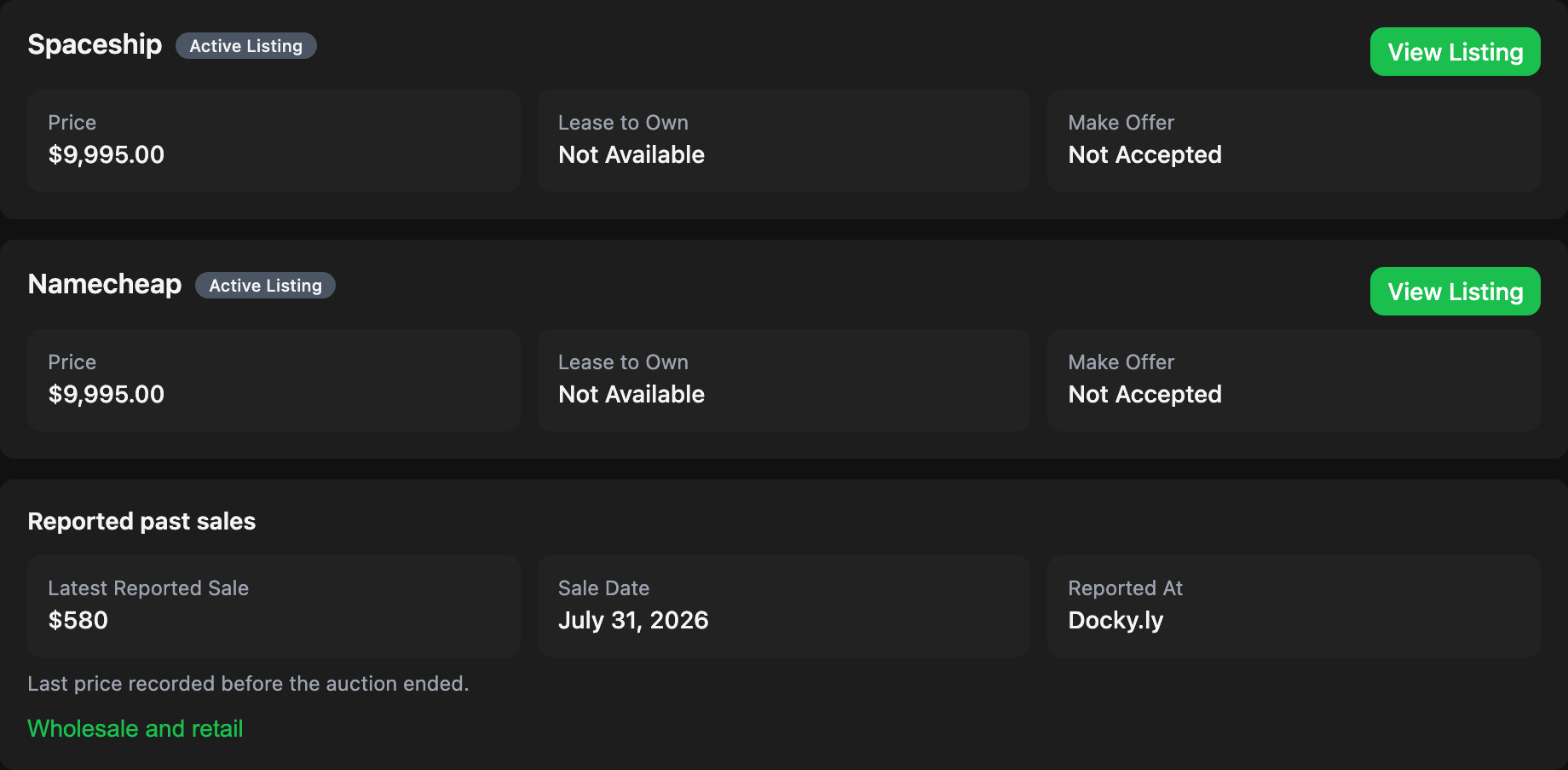
Below the listings, the card shows the last reported sale: $580 on July 31, 2026, at Docky.ly.
That’s about 17 times the price a few months later. Before you decide if it’s reasonable or not, it helps to know who paid $580 and why.
Who paid $580, and why it was so low
Docky.ly auctions names that expired and were caught when they dropped. The people bidding there are mostly domain investors. They aren’t buying a name to build a company on. They’re buying inventory to resell.
That’s a wholesale market. Think of a used-car dealer. They buy cars at a dealer auction, then price them higher on the lot. $580 is the auction price. $9,995 is the sticker in the window.
So $580 isn’t what the name is worth to you. It’s what investors were willing to pay for one more name in a portfolio.
Why the asking price is so much higher
An investor who pays $580 for a name isn’t planning to sell it for $700. The business doesn’t work that way.
- Most names in an investor’s portfolio won’t sell this year. The ones that do sell pay for the rest.
- Every unsold name costs a renewal fee every year.
- A good name can wait years (or even decades) for the right buyer.
- The marketplace usually keeps a cut of the sale.
Add that up and a retail ask many times the auction price is normal in this business. A big gap between $580 and $9,995 isn’t proof that someone is gouging you.
It isn’t proof the price is right, either. Some asks are a fair retail price. Some are more than the next buyer will ever pay. A past sale can’t tell you which one you’re looking at. It tells you what kind of number each one is, so you can judge the gap for yourself.
The app explains the difference
Under the sale there’s a green Wholesale and retail link. It opens a short explanation in Help, right beside the domain, so you don’t have to go searching while you’re trying to decide.
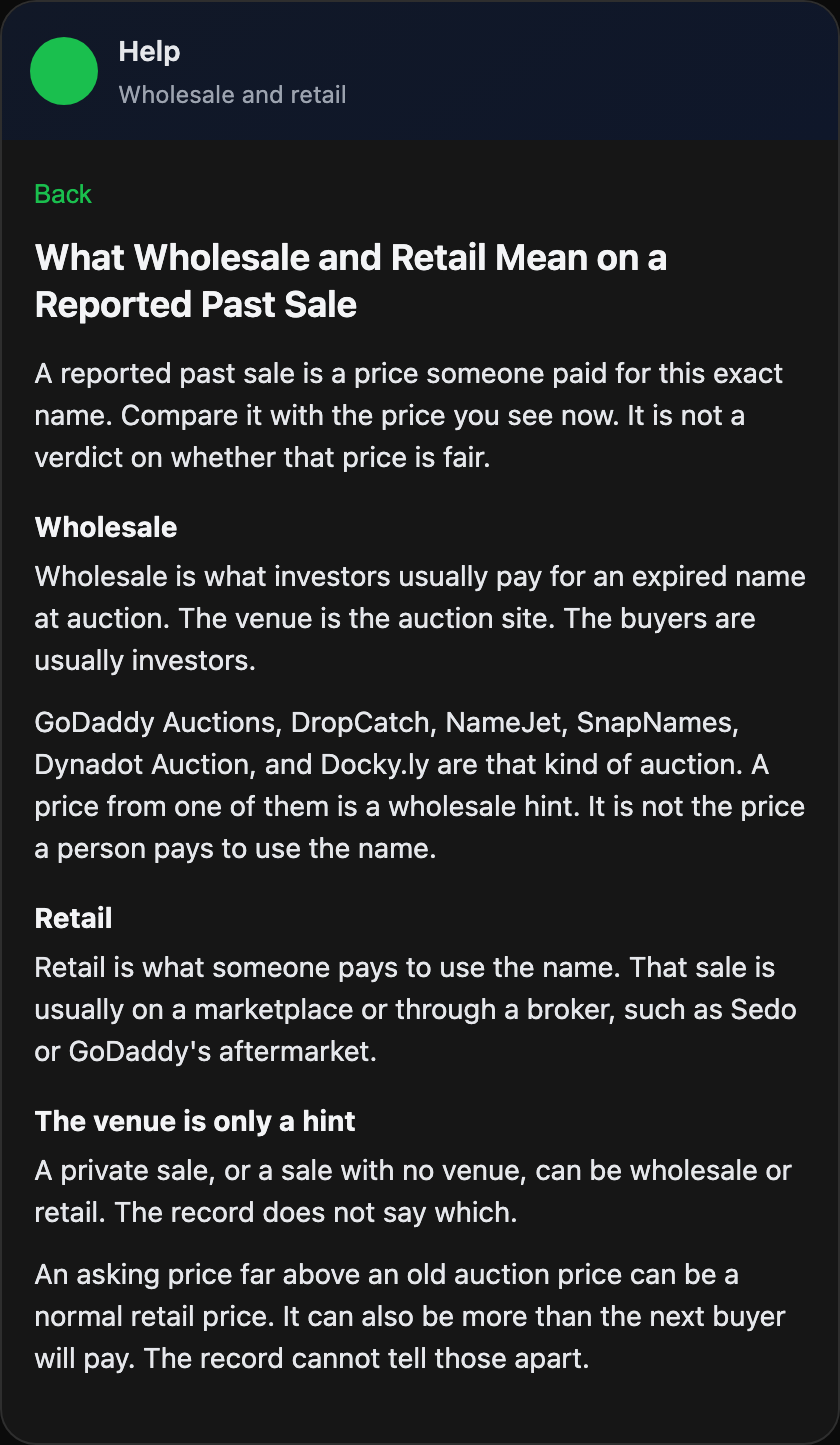
Wholesale is what investors pay at auctions like Docky.ly, GoDaddy Auctions, DropCatch, NameJet, SnapNames, and Dynadot Auction. Retail is what someone pays to use the name, usually on a marketplace or through a broker. A private sale, or one with no venue listed, could be either. The record doesn’t say.
Your options with a $9,995 ask
Once you know what the two numbers mean, you have three real choices.
Pay the asking price
If this is the name your business needs, and $9,995 fits what it’s worth to you, buy it. A buy-now listing goes to whoever pays first. While you think it over, someone else can click.
Weigh it against the alternative. What would it cost to build on a weaker name, or to rebrand in two years? For a name you plan to keep, what it’s worth to you matters more than what an investor paid for it.
Negotiate, if the listing allows it
Room to negotiate shows up on the listing, not in the past sale. When Make Offer says Accepted, the seller has said they’ll look at a number below the buy-now. The past sale gives you context for that number.
Keep your offer realistic. An investor who bought a name to resell it is unlikely to let it go for about what they paid. That isn’t the business they’re in. A first offer that’s too low can end the conversation before it starts.
On example.com, Make Offer says Not Accepted on both listings, so the only number on the table is $9,995. Some owners will still answer an inquiry made another way, such as through a broker. How to get a domain that’s taken walks through that path.
Wait, or look elsewhere
Asking prices change, and listings come down. Keep the name on your watchlist and we’ll email you when the price changes or the listing is removed. Waiting has a cost, though. A buy-now can sell to someone else while you wait.
If the gap is more than the name is worth to you, look at the same name on another extension, or a different name that does the same job. Watch those too, and you’ll see their listings and past sales the same way. It doesn’t have to be this price or nothing.
What the app won’t do
We show you the ask, whether offers are accepted, and the last reported sale, and we explain what kind of price each one is. We don’t know what the seller will accept, and we won’t pick a fair price for you. We don’t make offers or run the checkout. The decision is still yours. Now you can make it knowing what each number means.
Auctions, when the sale was at auction
The same block shows on the Auctions tab when the last sale happened at an auction. A marketplace-only sale stays on Marketplaces. Domain auction monitoring tells you when a name you watch is actually up for auction, and domain auctions explained covers how auction venues differ from a buy-now listing.
A seven-day trial is free and doesn’t ask for a card. Add the name you’ve been eyeing and open Marketplaces. If something on the card doesn’t match the listing, send us the domain in the in-app chat.
Be First to the Domain You Want
Get instant notifications the moment a domain name opportunity appears, with clear, step-by-step guidance to help you confidently secure it.
7-day free trial. No credit card required.